
Social
On this page, we present a consolidated overview of the key topics covered in the Social (S) section of our 2025 sustainability report. In our report, social matters relate to Vaasan Sähkö’s own workforce, workers in the value chain, as well as consumers and end-users.
TRANSLATION
Own workforce
(S1)
The Own workforce section provides information on, for example, the Vaasan Sähkö Group’s human resources policies, Code of Conduct, occupational health and safety, types of employment contracts, and the distribution of the workforce by gender.
In our double materiality assessment, we identified the following material impacts, risks, and opportunities related to our own workforce:
| Opportunity | By investing in a positive and stable employer brand, as well as the Group’s attractiveness and retention in the labor market, the business can be developed sustainably also in the future. |
| Opportunity and positive impact | Promoting employees’ work–life balance and well-being at work can generate a positive impact. A well-being workforce is also more productive, innovative, and motivated. |
| Potential negative impact | Investing in the health and safety of our own employees and in the prevention of occupational accidents is material for managing negative impacts. |
| Opportunity and positive impact | By providing employees with opportunities for training and skills development, employee well-being and productivity can be enhanced. |
| Opportunity and positive impact | Efforts related to equality and non-discrimination, as well as preventing inappropriate behavior in the workplace, have a positive impact on employee well-being, productivity, and motivation. |
The double materiality assessment examines two perspectives simultaneously: which sustainability matters are material from the perspective of the company’s business, and what significant impacts the company’s activities have on people and the environment.
Policies and actions
(S1-1, S1-3)
The policies and actions addressing the impacts, risks, and opportunities related to Vaasan Sähkö’s own workforce cover employee safety, well-being, equal treatment, as well as the development of a diverse and inclusive working community across the entire Group.
The Group’s ethical guidelines (Code of Conduct) apply to all boards, employees, and operations of Vaasan Sähkö and its subsidiaries.
Cornerstones and objectives
of corporate culture

Working community
- We aim to build a diverse, equal, inclusive, and well-being working community in line with our diversity plan.
- We emphasize early support, monitoring of work ability, and support provided by occupational health services.
- We use a proactive resource planning model in which human resources are planned and monitored to avoid excessive overall workload.

Continuous learning
- We encourage everyone to continuously develop their own competencies.
- A personal development plan defined in performance and development discussions supports continuous learning.
- Target for training days.

Occupational safety
- We participate in the Zero Accidents Forum.
- To support occupational safety, regular safety walks are organized for all employees.
- We have zero tolerance for threats, inappropriate behavior, harassment, and bullying.
- The Group has an externally audited occupational health and safety management system certified in accordance with ISO 45001, covering all employees across the Group.
- In addition to statutory insurance, Group employees are covered by a voluntary employer-provided medical expenses insurance.
- Operating model for occupational safety.
Targets
(S1-4)
Own workforce targets
| Unit of measurement | Target year | Target value | 2025 | |
|---|---|---|---|---|
| Occupational accidents | Number, pcs | Annually | 0 | 3 |
| Completed performance reviews | Percentage, % | Annually | 100 | 97 |
| Implemented safety walks | Percentage of planned, % | Annually | 100 | 100 |
| Employee Net Promoter Score | eNPS | Annually | > 50 | 68 |
| Inappropriate behavior and harassment | Number of reported cases, pcs | Annually | 0 | 5 |
| Training days (average) | Number, days | 2030 | 3 | 2 |
Characteristics of the own workforce and other workers
(S1-5, S1-6)
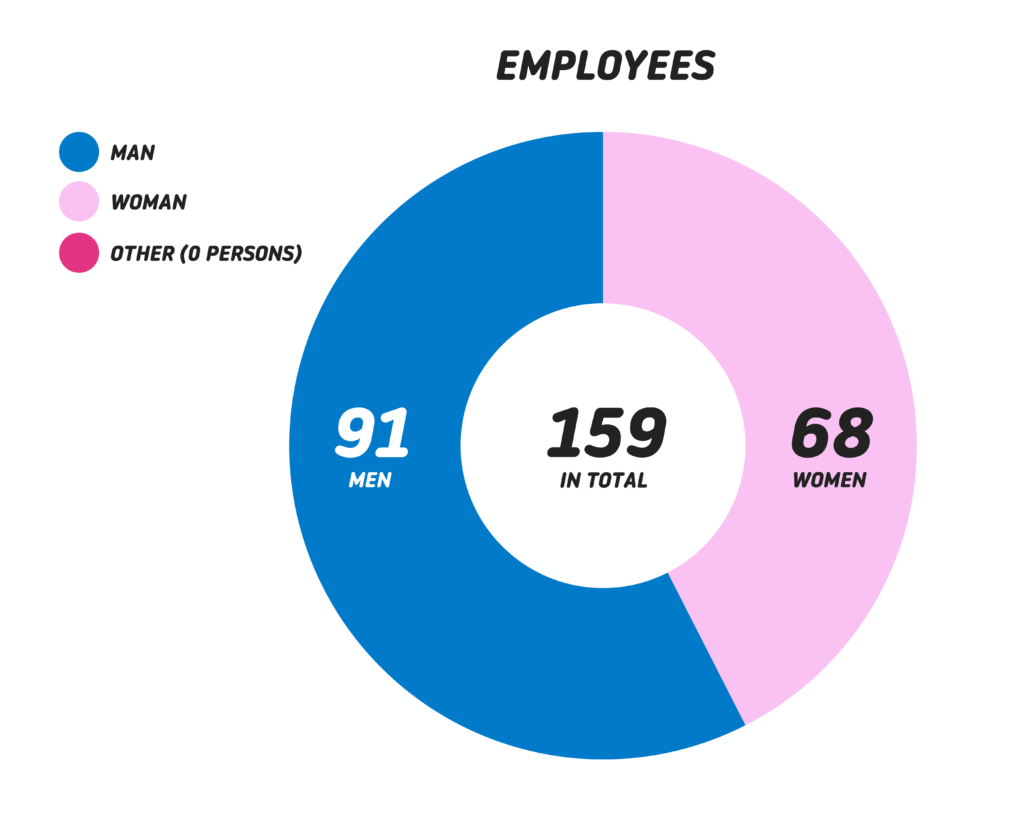
Workforce by gender (31 December 2025)
Age distribution of the workforce (31 December 2025)
| Women | Men | Total | |
|---|---|---|---|
| Under 30 years | 13 | 15 | 28 |
| 30–50 years | 31 | 59 | 90 |
| Over 50 years | 24 | 17 | 41 |
| Total | 68 | 91 | 159 |
Employment contract types (31 December 2025)
| Women | Men | Total | |
|---|---|---|---|
| Permanent | 55 | 82 | 137 |
| Fixed-term | 7 | 2 | 9 |
| Variable working hours | 6 | 7 | 13 |
Metrics
(S1-8, S1-12, S1-13, S1-15, S1-16)
Own workforce
| 2025 | |
|---|---|
| Gender distribution in the Group Executive Management Team | Men 6 (75%) |
| Women 2 (25%) | |
| Completed performance reviews | 97% |
| Training days (average) | 2 days |
| Employees covered by the company’s occupational health and safety management system | 100% |
| Fatalities resulting from (recorded) occupational accidents | Own workforce: 0 cases |
| Workers operating at the company’s worksites: 0 cases | |
| Recorded work-related health problems, suspected occupational diseases under investigation | 0 cases |
| Fatalities resulting from (recorded) work-related health problems | 0 cases |
| Occupational accidents (recorded) | 3 cases |
| – Frequency of these (incl. accidents leading to absence) | 0.0 (LTI1f) |
| Occupational accidents leading to absence (recorded) | 1 cases |
| – Days lost due to these | 2 days |
| Sickness absence rate | 1.6% |
| Sickness absence | 5,017 h |
| Reported cases of discrimination (incl. harassment) | 5 cases |
| Identified human rights violations | 0 cases |
| Fines, penalties, and compensation imposed in relation to cases of discrimination and human rights violations (EUR) | 0 EUR |
Equal pay audit 2025
An equal pay audit in accordance with the Finnish Act on Equality between Women and Men was carried out within the Group during 2025. According to the audit conducted in 2025, no unjustified pay differences between genders were identified.
Workers in the value chain
(S2)
We have assessed impacts and risks related to workers in the value chain primarily by reviewing suppliers, while also taking into account other workers linked to the supply chain.
Observations
- Employees from different parts of the value chain are involved in our projects.
- The upstream part of the value chain may include, for example, mining, processing, and manufacturing of raw materials, as well as storage and transport.
- Typical tasks in the value chain include various installation and construction activities, which may involve an increased risk of, for example, electric shock or burns.
In our double materiality assessment, we identified the following material impacts, risks and opportunities related to workers in the value chain:
| Potential negative impact | Focusing on the health and safety of suppliers’ workers and on the prevention of occupational accidents is important for managing negative impacts. |
| Potential negative impact | In the industry, an increased risk of human rights infringements has been identified in the upstream part of the value chain of, for example, solar panels and batteries. |
Policies and actions
(S2-1, S2-3)
Potential negative impacts related to workers in the Vaasan Sähkö Group’s value chain are managed, among other means, through the Supplier Code of Conduct and other contractual obligations.
The Supplier Code of Conduct was prepared during 2025, and from 2026 onwards it is intended to be included in all new or renewed procurement contracts or, alternatively, suppliers’ own codes of conduct with corresponding content will be used.
In certain forms of energy production, the industry has identified an increased risk of human rights violations in the upstream part of the value chain. To minimise risks, projects involving higher-risk forms of production may, where necessary, use external partners, for example to investigate the origin of materials.
For 2025, Vaasan Sähkö is not aware of any reported cases related to workers in the upstream or downstream parts of the value chain where the United Nations Guiding Principles on Business and Human Rights, the ILO Declaration on Fundamental Principles and Rights at Work, or the OECD Guidelines for Multinational Enterprises would not have been complied with.
Vaasan Sähkö is currently not able to comprehensively assess, across the entire value chain, whether international principles may have been violated. Should violations be identified, Vaasan Sähkö would primarily require corrective actions and, secondarily, terminate contracts if the corrective actions agreed together were not implemented.
Interaction
(S2-2)
Vaasan Sähkö enables interaction with workers in the value chain through regular communication and various channels.
Here are some examples of our approaches to engaging with workers in the value chain.

Supplier meetings
Regular supplier meetings are organized with key service providers and in connection with larger projects.

Stakeholder communication
We communicate regularly on our strategy, targets, and actions to our stakeholders.

Occupational safety walks
Some of the annual occupational safety walks are carried out at different worksites where employees of partners or their subcontractors are working.

Reporting channel
Our website includes a reporting channel (Whistleblowing), which, among other things, provides workers in the value chain with an opportunity to report observations where the reporter believes that the Vaasan Sähkö Group’s guidelines or applicable laws and regulations may be violated.
Targets
(S2-4)
Workers in the value chain
| Unit of measurement | Target year | Target value | 2025 | |
|---|---|---|---|---|
| Occupational accidents | Number, pcs | Annually | 0 | 2 cases |
| Human rights violations in the value chain | Number, pcs | Annually | 0 | 0 cases |
Consumers and end-users
(S4)
As an organization critical to security of supply, Vaasan Sähkö’s operations have a significant impact directly on customers and end-users and, through them, on society as a whole. In actions related to end-users, particular emphasis is placed on:
- information security and data protection
- general preparedness and continuity management
- ensuring the security of energy supply.
In our double materiality assessment, we identified the following material impacts, risks, and opportunities related to consumers and end-users:
| Risk and potential negative impact | Geopolitical uncertainty has highlighted the importance of information and cyber security as well as data protection in a sector critical to security of supply. |
| Risk and positive impact | Through competitive pricing, the Group seeks to promote the acceptance of prices among stakeholders, while at the same time ensuring financial responsibility by safeguarding a sustainable financial base for the company. |
| Positive impact | Promoting the security of energy supply has a positive impact on consumers and end-users. |
| Opportunity and positive impact | By investing in high-quality data and a strong digital customer experience, the company aims to provide added value to its customers while improving its competitiveness in the market. |
Policies and actions
(S4-1, S4-3)
Certifications
Our management system meets the requirements set by stakeholders related to our operations, such as consumers and end-users, as well as by authorities and standards applicable to quality management systems. The systems are certified by third parties.
In addition, our operations are guided by the policies published on the websites of the parent company and our electricity distribution company.

Quality management system ISO 9001
The certification focuses on managing and improving the quality of the company’s operations as well as enhancing customer satisfaction.
Occupational health and safety management system ISO 45001
Vaasan Sähkö’s occupational health and safety management system is certified in accordance with ISO 45001, and occupational health and safety management is based on a model of continuous improvement.
Information security ISO 27001
Ensures the systematic establishment, implementation, maintenance, and continuous improvement of the organization’s information security management system (ISMS).
Environmental management system ISO 14001
The certification focuses on environmental responsibility by committing the company to improve its operations from an environmental perspective.
Processing of personal data
We process personal data for various purposes in connection with customer service as well as contract and billing processes and the development of services. In the processing of personal data, we comply with data protection legislation and good data protection practices. Privacy statements are available to consumers and end-users on our website.
Improving security of supply
The essential commodities we supply – heat and electricity – have a direct impact on people’s living environment and health. Therefore, investing in security of supply is particularly important in order to minimize negative impacts on end-users, such as supply interruptions.
Vaasan Sähköverkko’s investments
Vaasan Sähköverkko’s annual investments in improving security of supply amount to approximately EUR 15 million.
By spring 2026, 55 percent of the medium-voltage network and 76 percent of the low-voltage network are underground. The target is to increase the cabling rate of the medium-voltage network to 66 percent and the low-voltage network to 82 percent by the end of 2036.
In addition to network investments, security of supply is maintained through planned maintenance of the electricity network.
New energy meters for district heating customers
In 2025, a large-scale district heating remote reading upgrade project was launched, under which our district heating customers will receive new energy meters by 2028. In 2025, approximately 30 percent of customers’ remote reading devices were replaced to meet future requirements related to the technological transition of mobile networks.
Interaction
(S4-2)
Vaasan Sähkö has several interaction channels in place for transactions and communication with customers and end-users.
Below are examples of how we engage with consumers and end-users.

Customer service
The most popular service channels among our customers are telephone, email, chat, website, and mobile application.
Other communication
We primarily keep in contact with consumers and end-users through electronic channels. For example, on our website and in other customer communications, we provide information about our operations as well as our products and services, and share tips that are useful for consumers in relation to energy use.

Surveys
We take part in nationwide customer satisfaction surveys annually across Finland.
In addition, we monitor satisfaction with our customer service through a widely used NPS measurement (Net Promoter Score).
Providing feedback
Vaasan Sähkö’s website includes forms for providing feedback and submitting complaints. There is a defined process in place for handling customer feedback and complaints to ensure their systematic processing.
Targets
(S4-4)
Consumers and end-users
| Unit of measurement | Target year | Target value | 2025 | |
|---|---|---|---|---|
| Customer satisfaction, continuous measurement | Net Promoter Score (NPS) | Annually | > 45 | 54 |
| Quality of electricity distribution | SAIDI, average interruption duration per customer (h) | 2030 | 1.5 | 2.25 h |
| Quality of electricity distribution | SAIFI, average number of interruptions per customer, pcs | 2030 | 2.0 | 2.44 pcs |
| Quality of district heating distribution | SAIDI, average interruption duration per customer (h) | Annually | < 2.0 | 1.0 h |