
Why do electricity contracts have different prices? This is how the price of electricity is formed
Electricity contract prices vary depending on how and when the electricity is purchased: exchange electricity follows the market price for the next day, while the price of other contract types is based on the predicted electricity price further into the future. Future predicted electricity prices are affected by variations in demand, weather, fuel prices, and…
Why does the price of electricity vary from day to day? Why is electricity usually more expensive in winter and in the middle of the day? Jakob Frants, Sales Manager at Vaasan Sähkö, explains the factors that affect the fluctuations in electricity prices.
Why do electricity contracts have different prices?
The price differences between electricity contracts depend mainly on the length of the period the electricity price has been set for, i.e. whether the price is determined for 15 minutes, a month or a year ahead. Since the market price of electricity varies quarter by quarter and has been determined only until the next day, any price estimates that look beyond that are based on a forecast of how supply and demand may vary. The price differences in electricity contracts are therefore also affected by who will bear the price risk that comes with the forecast.
- In exchange electricity, the customer bears the entire price risk. Since the customer always pays for electricity according to the current market price, the price can quickly rise or fall.
- In a fixed-price contract, the risk is borne by the electricity supplier, which is usually reflected in a slightly higher but predictable contract price.
- In a hybrid contract, the risk is shared between the customer and the electricity supplier: the fixed share provides stability and the market share enables savings.
Exchange electricity is a 15-minute market
The price of exchange electricity is determined on the electricity exchange, i.e. Nord Pool, the day before the electricity is delivered. The so-called spot price varies every quarter of an hour depending on the demand and supply of the electricity. Consumers can check tomorrow’s exchange electricity prices at 2 p.m. the day before.
Since each quarter can have its own price, price fluctuations can be rapid and sometimes sharp. For example, a cold winter increases electricity demand, which also raises the price. Thus, windy and hot days know more electricity produced with cheap production forms, which usually lowers the price of electricity.
In a fixed-price contract, the price is set from 6 months to 2 years
In a fixed-price contract, the price is set in advance for a certain period, either for six months, a year or two. In these cases, the electricity seller buys electricity further into the future via the derivative market by predicting supply and demand.
The price is the same throughout the contract period, i.e. disturbances in power plants or price increases or decreases caused by weather do not affect the price paid by the customer.
However, when forecasts change, prices for new fixed-price contracts can vary. Therefore, you can get a fixed-price contract today at a different price than, for example, in six months’ time. Once the contract has been made, the price will no longer change.
In a non-fixed-term contract, the price changes several times a year
In a non-fixed-term contract, the price is reviewed regularly, usually once a month or quarterly, i.e. four times a year. The electricity company follows the market price and adjusts the price for the next period according to supply and demand.
The customer’s price does not fluctuate daily, as in the case of exchange electricity, but reacts to market changes over a longer period.
A hybrid contract combines exchange electricity and fixed price
A hybrid contract combines the best features of a fixed-price contract and exchange electricity. In practice, one part of the electricity price is fixed and the other part follows the market price on the exchange electricity.
A hybrid contract gives the consumer the opportunity to balance the price risk.
What else does the price of electricity consist of?
The total price of electricity consists of three factors: electrical energy, electricity transmission and taxes. Electrical energy accounts for about 40 percent of the electricity bill. It includes the purchase price of energy and the electricity company’s margin, which covers the costs and risks of energy procurement.
The distribution price is paid to the electricity network company and covers costs of maintaining the electricity network.
The taxes include value added tax and taxes on the use and transmission of electricity.
Why does the price of electricity fluctuate so sharply?
The price of electricity rises or falls depending on how much electricity is needed and how much can be produced. Following things have the biggest impact:
- In exchange electricity, the price is affected by the weather forecasts for the next day and the estimated consumption of industry and households. Wind, solar and hydro power are cheap production forms, and nuclear power is usually produced at a reasonable price. When consumption increases on cold, chilly days or cloudy and windless periods, there is not enough cheap production available. In this case, more expensive forms of production, such as gas, oil or coal power, are required, which increases the spot price. Likewise, spot prices fall on windy and sunny days when cheaper forms of production are available.
- In fixed-price contracts, the price is affected by the forecast for the next six months, one or two years. The electricity companies predicts consumption and production at different times of the year and price the contract accordingly. Individual cold or still days do not affect the price of a fixed contract, but long-term differences are reflected in the price.
- Fluctuations in fuel prices, such as natural gas, coal and oil, also affect the market price of electricity. The increase in the price of these permits also increases the market price. In exchange electricity, the customer pays for these changes in real time. In fixed-price contracts, the electricity company has taken any changes into account in advance.
Why is a non-fixed-term contract often more expensive than a fixed-term contract in winter?
The price of a non-fixed-term contract, such as Vaasan Sähkö’s Basic Electricity, is updated four times a year.
The price for the coming quarter will be informed to the customer approximately one month in advance. The price is based on the derivative price level during the priced quarter. Winter quarters are typically more expensive than spring and summer, as electricity demand increases during the winter. To meet demand, more expensive production methods are introduced, which raise prices.
The price of a fixed contract, on the other hand, is set in advance for the entire contract period. The price takes into account the average price levels of winter and summer.
What is a hybrid contract in practice?
With a hybrid contract, you get the stability of a fixed-price contract combined with the possibilities of an exchange electricity contract to influence the total amount of the electricity bill.
In Vaasan Sähkö’s Influencer contract, the consumer pays a basic fee, an energy fee per kilowatt hour and a so-called own influence based on exchange electricity prices.
Own influence is formed according to whether the electricity has been used during the cheap or expensive moments of the month. If consumption takes place at the cheap times, the own impact will be negative, which can reduce the share of the energy tax. If consumption takes place mostly during the expensive moments, the sum of the invoice may rise. The Influencer product can be purchased as a non-fixed or a fixed-term contract.
Good to know! The fixed energy price of a hybrid contract is lower than the corresponding energy price of a fixed-price contract, because in a hybrid contract, the customer bears part of the price risk. However, this should not be seen just as a risk: the customer can also save money by optimizing their consumption to cheaper moments. In addition, the absolute price variation of exchange electricity is not directly reflected in the invoice, but the total sum is calculated based on the customer’s consumption compared to the average exchange electricity price during the month in question.
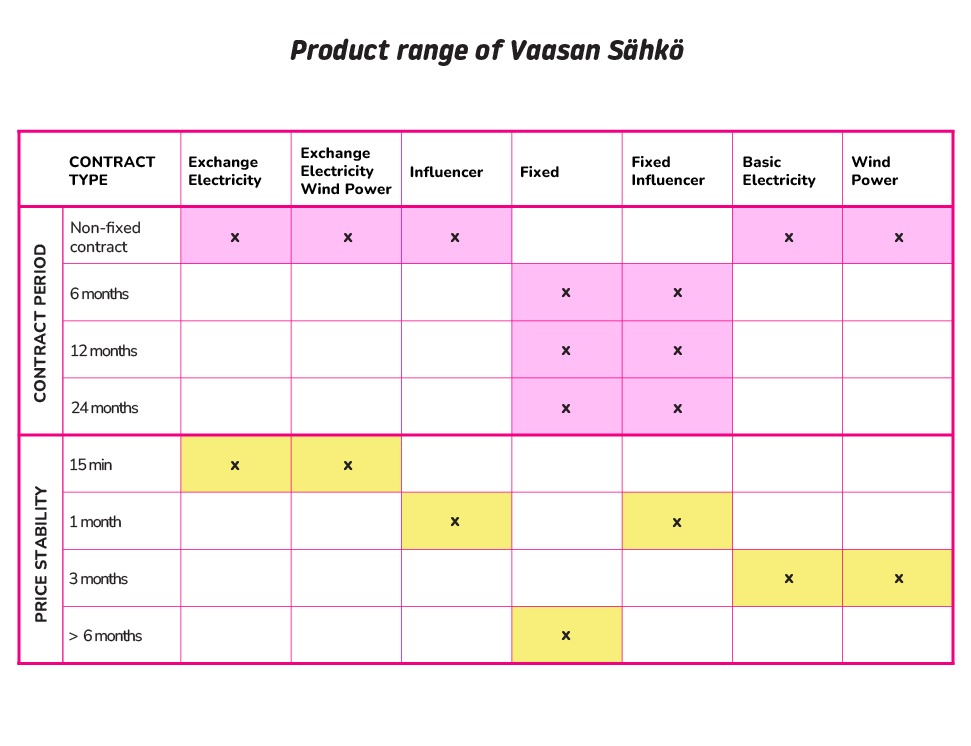
The electricity contract types vary according to the contract period and how sharp price fluctuations are possible. The table shows how often prices can vary in different types of contracts: In an exchange electricity contract, the price varies every 15 minutes, and in a fixed-price contract, the price can be the same for up to two years.
All electricity contracts presented in the table are based on c/kWh pricing. In addition to these contracts, we provide different sizes of monthly packages with a fixed price (S, M, L and XL), which are suitable for apartment houses.
electricity contract vocabulary

The price of exchange electricity, which is set in the Nord Pool day-ahead-auction one day in advance. The price varies every 15 minutes according to supply and demand.

A fixed price is determined for the the whole contract period, and will stay the same for usually 1 to 2 years.
Combines the stability of a fixed price and the opportunity to influence the total sum of the invoice.
A contract type where the electricity price is updated four times a year. From Vaasan Sähkö you can get a non-fixed-term contract by buying our products Basic Electricity or Wind Power.
Derivative contracts: Electricity procurement that an electricity company makes in advance for a certain period of time in order to be able to offer customers a fixed price contract.
Expert: Jakob Frants, Sales Manager, Vaasan Sähkö.
Frants is responsible for electricity sales to private customers and small businesses, product pricing, the development of contract types, and Smart Home services.