
Environment
On this page, we present a consolidated overview of the key topics covered in the Environmental (E) section of our Sustainability Report 2025. In our report, environmental topics focus on climate change as well as biodiversity and ecosystems.
TRANSLATION
Climate change (E)
In our double materiality assessment, we identified the following material impacts, risks, and opportunities related to climate change (E1 standard):
| Risk | Uncertainty related to weather conditions poses a risk to electricity availability, consumed volumes, and pricing. |
| Risk | Extreme weather events caused by climate change may have an impact on energy production and distribution. |
| Negative impact | The operations of the Vaasan Sähkö Group and its value chain generate greenhouse gas emissions. |
| Opportunity and posivite impact | The increase in the supply of renewable energy raises the need for energy storage solutions and for optimizing energy use. These investments offer opportunities to increase sales and profitability while also reducing C02-emissions. |
| Opportunity and posivite impact | The electrification of society and the transition to low‑carbon energy offer new business and investment opportunities, while at the same time enabling C02-emissions reductions. |
| Opportunity and risk | Investments in sustainable new technologies present financial opportunities, but also carry a risk of investment failure. |
| Risk | The use of biofuels and combustion involves a risk related to uncertainty in future regulation. |
| Opportunity and positive impact | Improving energy efficiency has a positive environmental and economic impact. |
The double materiality assessment examines two perspectives simultaneously: which sustainability matters are material from the perspective of the company’s business, and what significant impacts the company’s activities have on people and the environment.
Transition plan for climate change mitigation
(E1-1)
The first version of Vaasan Sähkö’s transition plan for climate change mitigation was completed in 2025. The transition plan includes annual emissions reduction targets and the key actions to achieve them, with a particular focus on electricity and district heating production at facilities with long operational lifetimes.
Coming soon: More detailed information about the transition plan
The Green Transition Consumer Protection Directive introduces new requirements from September 2026. Therefore, we have removed information about our climate transition plan and the carbon neutrality roadmaps for electricity and district heating production from this page, as the content did not meet the requirements of the directive. We will publish this information in an updated format at a later date.
Risk identification, scenario and resilience analysis
(E1-2, E1-3)
As part of the transition plan for climate change mitigation, a climate risk analysis was conducted in 2025. The analysis assessed climate‑related risks from the perspectives of location, infrastructure, the value chain, and different climate scenarios.
Vaasan Sähkö’s climate scenario analysis primarily draws on publications by the Intergovernmental Panel on Climate Change (IPCC) and the Finnish Meteorological Institute, and examines modelled outcomes representing two extreme ends of climate scenarios.
- Scenario 1: Successfull transition
- Climate actions and targets in line with the Paris Agreement are successfully implemented
- Global warming is halted and average temperatures begin to decline
- This scenario requires ambitious climate action and strong international cooperation.
- Scenario 2: Unsuccesfull transition
- International climate action remains limited
- The objectives of the Paris Agreement are not achieved, global temperatures continue to rise, and climate change significantly reshapes environmental conditions and living environments.
risk types
In the climate analysis, climate‑related risks are assessed across different time horizons and at various
points along the value chain. For the purposes of the analysis, risk types are categorized
into transition risks and physical risks as follows:

Transition risks
- Energy regulation
- Increase in electricity prices
- Increase in district heating prices
- Increase in raw material and production costs
- Increase in internal costs
- Increased costs for suppliers related to the transition to green energy
- Changes in the production and delivery costs of green energy
- Loss of revenue.

Fysical risks
- Physical damage to assets resulting from climate‑related events
- Decrease in revenue due to climate‑related events
- Supply disruptions
- Disruptions to production and operations.
Climate change mitigation and adaptation: policies and actions
(E1-4, E1-5)
Vaasan Sähkö’s strategic objective guiding its operations is to achieve carbon‑neutral base production by the end of the 2020s and to phase out fossil fuels by 2030. As a result, electricity and heat production with long annual operating hours will no longer be based on fossil fuels as primary fuels. However, oil will continue to be used at the production facilities for specific purposes such as start‑up operations.
Central policies and actions

Investments in C02-emission-free and renewable energy
The Group invests in wind and solar power as well as in other solutions that reduce carbon dioxide emissions from energy production.
Flexible and innovative energy solutions
Thermal energy storage facilities, electric boilers and sector coupling solutions increase the flexibility of the energy system and support the integration and utilisation of renewable energy.
Transition away from fossil fuels
The use of coal in district heating is being phased out and will be fully discontinued 2029 at the latest. Replacement solutions include, among others, biocarbon and the utilisation of waste heat.
Climate change adaptation and security of supply
Physical climate risks are addressed through investments in the reliability and resilience of energy production and distribution.
Targets
(E1-6)
Vaasan Sähkö’s climate‑related targets and performance are presented in the table below.
Climate change
| Unit of measurement | Target year | Target value | 2025 | |
|---|---|---|---|---|
| Carbon neutral base production | Carbon dioxide emissions from base production, tCO₂e | 2030 | 19,747 | 169,136 |
| Net-zero emissions | Target achieved, yes/no | 2050 | Yes | No |
| Commitment to SBTi targets | Committed, yes/no | 2026 | Yes | No |
Energy consumption and energy mix
(E1-7)
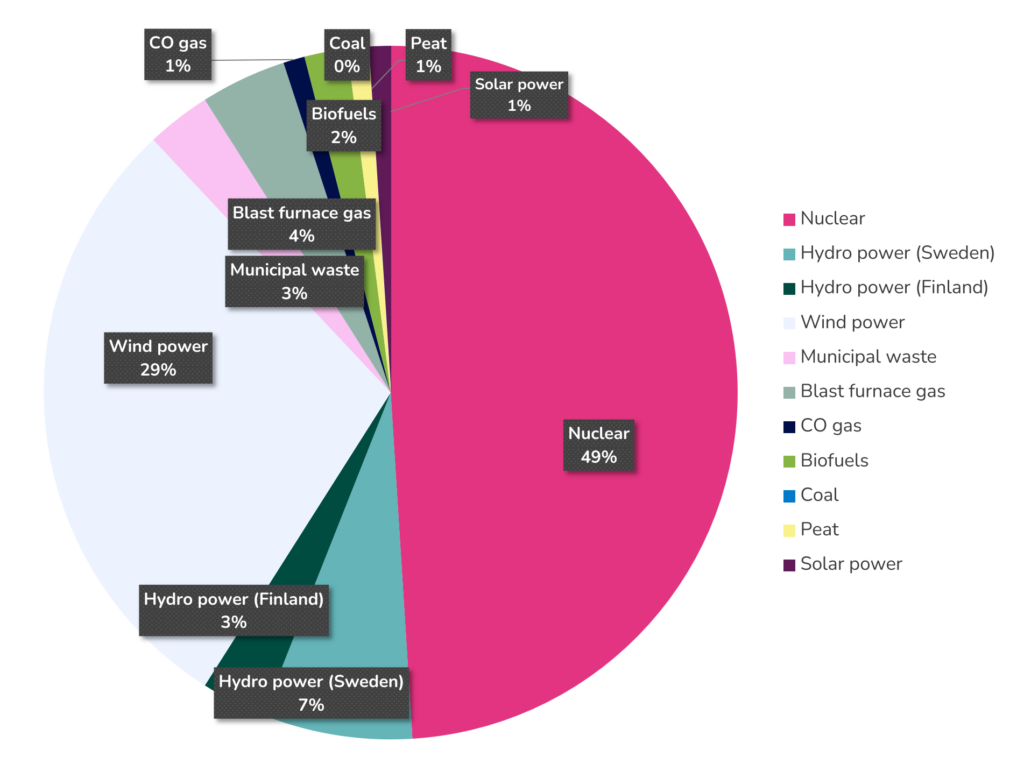
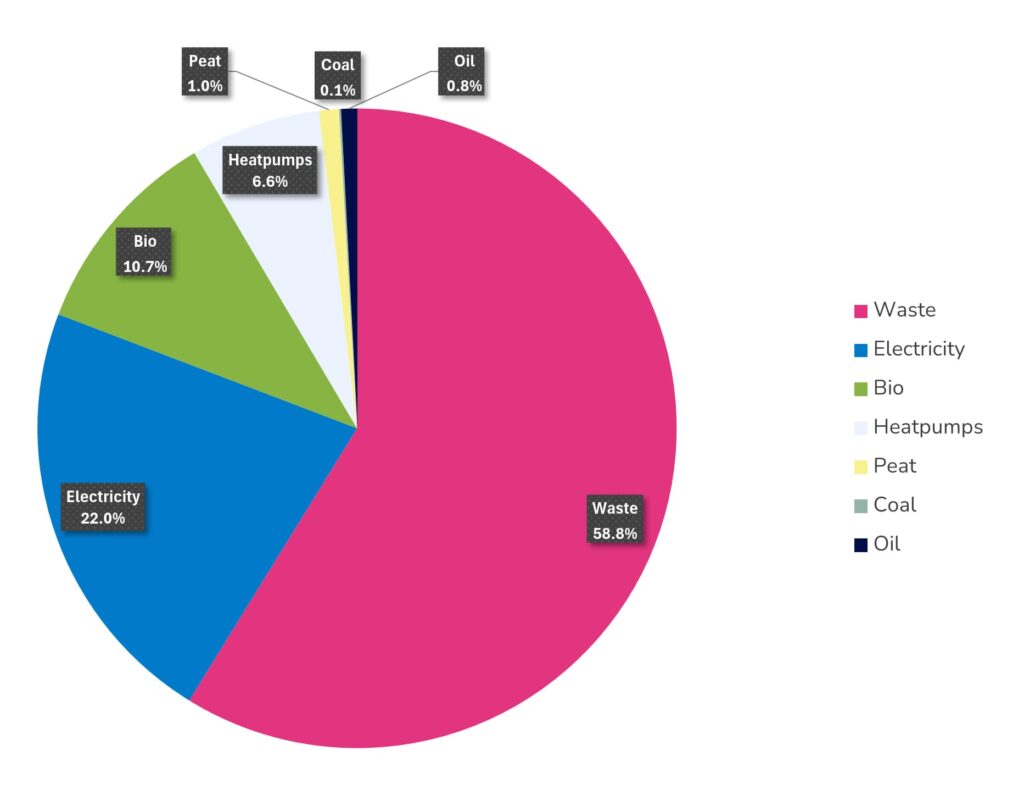
Vaasan Sähkö uses a range of different fuels in electricity and heat production. The energy sources used are presented in the table below.
Energy consumption, MWh
| 2025 | |
|---|---|
| Total renewable sources | 6,731 |
| Total nuclear sources | 15,205 |
| Total fossil sources | 35,359 |
| – coal and coal products | 0 |
| – crude oil and oil products | 6,779 |
| – natural gas | 0 |
| – other fossil fuels | 0 |
| – electricity, heat, steam or cooling purchased or acquired from fossil sources | 28,580 |
| Total consumption | 57,295 |
Fuel mix of electricity and district heating production
Electricity
Heat
greenhouse gas emissions
(E1-8)
GHG Protocol‑based calculation
Vaasan Sähkö calculates its greenhouse gas emissions in accordance with the Greenhouse Gas Protocol, applying a financial control approach to define organisational boundaries. Emissions are reported in carbon dioxide equivalents (CO₂e).
Greenhouse gases included
The calculation takes into account carbon dioxide (CO₂), methane (CH₄) and nitrous oxide (N₂O), as well as fluorinated gases, which have different impacts on the climate.
Coverage: Scopes 1–3
The calculation covers direct emissions from the Group’s own operations (Scope 1), emissions from purchased energy (Scope 2), and a significant share of emissions from the value chain (Scope 3).
Development
The emissions calculation is based on both measurement‑based and expenditure‑based data, and the coverage of Scope 3 emissions will be expanded in the coming years.
Greenhouse gas emissions
| tCO₂e, or as otherwise reported | 2025 |
|---|---|
| Scope 1 greenhouse gas emissions | |
| Gross Scope 1 greenhouse gas emissions | 2,115 |
| Share of Scope 1 GHG emissions covered by EU ETS (%) | 75.7% |
| Scope 2 greenhouse gas emissions | |
| Location‑based Gross Scope 2 greenhouse gas emissions | 19,364 |
| Market‑based Gross Scope 2 greenhouse gas emissions | 19,286 |
| Material Scope 3 greenhouse gas emissions | |
| Total gross indirect Scope 3 greenhouse gas emissions | 195,851 |
| 1 Purchased goods and services | 12,030 |
| 2 Capital goods | 5,877 |
| 3 Fuel‑ and energy‑related activities (not included in Scope 1 or Scope 2) | 169,136 |
| 4 Upstream transportation and distribution | 1,320 |
| 5 Waste generated in operations | 6,177 |
| 6 Business travel | 18 |
| 7 Employee commuting | 62 |
| 11 Use of sold products | 1,231 |
| Total greenhouse gas emissions | |
| Total greenhouse gas emissions, location-based | 217,330 |
| Total greenhouse gas emissions, market-based | 217,252 |
| Direct biogenic Scope 1 emissions | 188 |
The calculation principles for greenhouse gas emissions covering Scopes 1–3 are presented in the main report on page 19.
Carbon credits, internal carbon pricing and anticipated financial effects
(E1-9, E1-10, E1-11)
- Vaasan Sähkö does not remove or compensate greenhouse gas emissions and did not use carbon credits in its own operations or value chain in 2025.
- The company is preparing a net‑zero target in line with the Science Based Targets initiative (SBTi), after which residual emissions will be compensated through permanent, approved carbon removal methods.
- Climate‑related risks and opportunities have been identified, and their anticipated financial effects will be assessed and reported in more detail in the coming years.
Biodiversity and ecosystems
(E4)
Vaasan Sähkö has identified biodiversity as one of the Group’s key sustainability themes. Electricity and heat production and distribution have both direct and indirect impacts on biodiversity and ecosystems across the value chain, in particular through:
- land and water use,
- infrastructure construction, and
- greenhouse gas emissions.
At the same time, the Group’s business is dependent in the long term on well‑functioning ecosystems and the ecosystem services provided by nature. Vaasan Sähkö is systematically developing its expertise and operating practices to identify, assess and manage impacts on biodiversity.
In our double materiality assessment, we identified the following material impacts, risks and opportunities related to biodiversity and ecosystems (ESRS E4):
| Negative impact and risk | Different forms of energy production, as well as the construction and maintenance of electricity distribution and district heating networks, have impacts on biodiversity and are dependent on ecosystem services provided by nature. |
Biodiversity and ecosystem transition plan
(E4-1)
Vaasan Sähkö has not published a biodiversity and ecosystems transition plan as referred to in the ESRS E4 standard.
The aim is to prepare a biodiversity and ecosystems transition plan for Vaasan Sähkö and to publish it no later than in connection with the publication of the sustainability report for 2026.
The transition plan will be aligned with the Kunming–Montreal Global Biodiversity Framework and will include the Group’s key biodiversity‑related objectives, the main actions to achieve these objectives, as well as the financing of the plan, responsibilities and monitoring.
Biodiversity and ecosystems: policies and actions
(E4-2, E4-3)
Vaasan Sähkö systematically develops the management of biodiversity as an integral part of its sustainability work. The Company identifies and manages its impacts on nature primarily by avoiding and mitigating impacts, and secondarily by restoring and enhancing ecosystems.
Key policies and actions

Identification of impacts and dependencies:
Vaasan Sähkö applies the TNFD LEAP approach to identify and assess its nature‑related impacts and dependencies. The Company reviews its activities across the entire value chain and from the perspective of the key drivers of biodiversity loss.
Siting and planning
Energy infrastructure is, where possible, located within existing built environments, and areas of high nature conservation value are avoided.
Energy production
Transitioning to renewable energy sources and a significantly reducing the use of fossil fuels.
Permits and assesments
Environmental impact assessments, authority cooperation, and permitting procedures form an integral part of all significant projects.
Targets
(E4-4)
Vaasan Sähkö’s objective is to identify impacts on biodiversity and to better integrate biodiversity considerations into its daily operations, alongside the Company’s climate‑related efforts, by establishing biodiversity‑related targets, metrics, and actions to safeguard biodiversity
The Company’s objective is to develop the first version of a biodiversity‑related transition plan by spring 2027.
Vaasan Sähkö’s biodiversity‑ and ecosystem‑related targets and results are presented in the table below.
Biodiversity and ecosystems
| Unit of measurement | Target year | Target value | 2025 | |
|---|---|---|---|---|
| Transition plan | Published/ complete/ incomplete | 2027 | Complete | Incomplete, |
| Promotion of energy efficiency in accordance with voluntary energy efficiency agreements | Progress in line with targets, yes/no | Annual | Yes | Yes, *) |
*) A new energy efficiency agreement period began in 2026.
Metrics
(E4-5)
Climate change is one of the most significant drivers of biodiversity loss globally, and reducing emissions is a key means of mitigating its impacts on nature. Vaasan Sähkö’s climate targets and emission reduction measures are disclosed in accordance with ESRS E1 and are therefore not addressed separately within the biodiversity targets.
Biodiversity and ecosystems
| Unit of measurement | 2025 | |
|---|---|---|
| Operational sites located in or near sensitive areas | Number (pcs) | *) |
| Bird diverters and markers installed on overhead power lines | Number during the year (pcs) | *) |
| Network infrastructure located in protected areas and Natura 2000 sites | Line length (km) | *) |
| Transition plan | Published/ complete/ incomplete | Incomplete |
| Promotion of energy efficiency in accordance with energy efficiency agreements | Progress in line with targets, yes/no | Yes |
*) Not reported for 2025; data will be collected during 2026.