
Electricity contract guide: which contract is right for you?
The choice of electricity contract depends on what kind of electricity user you are and how much you can influence your own consumption. It is also worth considering whether you prioritize savings or convenience.
Lena Lainio, Sales Manager at Vaasan Sähkö shares tips to help you determine what type of electricity contract best fits your everyday life and lifestyle: fixed-term agreement, exchange electricity, or an open-ended contract.
How to choose an electricity contract – 3 key questions
- What kind of electricity user are you?
Is your consumption steady throughout the day, or concentrated to the mornings and evenings? Are you interested in tracking prices and reacting to them, or would you rather forget about electricity once the contract is signed?
- What is your risk tolerance?
Do you sleep soundly even if electricity prices fluctuate? Are you willing to tolerate price changes in the hope of saving? Do you have the patience for long-term savings, or do you value a predictable electricity bill more?
- How significant is the electricity bill for your finances?
Is your top priority finding the lowest price, or do convenience and peace of mind matter more? Can your wallet handle winter price spikes?
Lena Lainio’s tip: If you’ve had the same electricity contract for years and are unsure if it’s still the best option, check your consumption history. You can do this easily in the Vaasan Sähkö app or online service. By tracking when and how you use electricity, you can more easily determine which contract matches your lifestyle best. Our customer service can also assist you with these questions.
Fixed-term contract – predictability and security
A fixed-term contract is ideal if you want peace of mind and don’t want to worry about electricity prices after signing a contract. You can choose a contract period of 6, 12 or 24 months, with the price staying the same throughout.
Pros:
- Worry-free and simple – price fluctuations won’t affect your daily life.
- You can choose the duration of the contract.
- Fixed price protects you from price spikes, especially in winter.
Note:
The average price may be a bit higher than the market price, for example in summer when electricity is usually cheaper due to lower production costs and consumption.
A fixed-term contract is tied to a specific address, but if you move, you may terminate the contract.
Exchange electricity contract – opportunity to save
Exchange electricity suits you if you want to monitor electricity prices. It’s not a “buy and forget” contract, but you can save money by using electricity at cheaper times.
Spot electricity benefits especially households with above-average consumption, such as those with large homes, many residents, and many devices. You benefit most if you have a large water heater that can be heated at cheaper times, or an electric/hybrid car that can be charged at suitable times.
Solar panels also offer added benefits: on sunny days, you can cover your own consumption and only pay for electricity in the evening and at night.
Pros:
- You can schedule consumption for cheaper times and save.
- In the long run, often the most affordable choice for active optimizers.
Note:
Exchange electricity isn’t ideal if your usage is concentrated to weekday mornings and evenings when prices peak, or if your total usage is low.
Lena Lainio’s tip: Use the Vaasan Sähkö Smart Home app. It automatically schedules charging for electric or hybrid cars at the cheapest times. With the Power Hub device, you can monitor energy consumption in real time.
Open-ended contract – flexibility without commitment
An open-ended contract suits you if you value simplicity and flexibility and don’t want to commit long-term. If you change your mind, you can terminate the contract with two weeks’ notice.
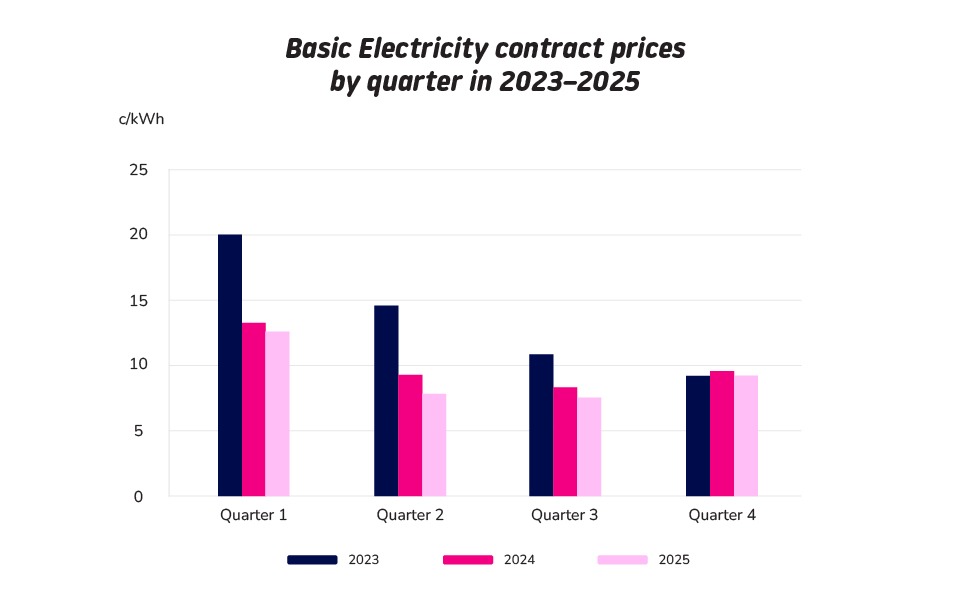
The price is updated quarterly, i.e. four times a year, and responds more slowly to the market than spot electricity. Usually, summer months are slightly cheaper, while prices rise somewhat in winter.
Pros:
- Easy and convenient. The contract rolls on without you needing to do anything.
- Flexibility. You can change or end the contract with two weeks’ notice.
Note:
The price is generally a bit higher than the cheapest available contracts.
Apartment building, terraced house, or detached house? Keep this in mind
- Apartment building: Consumption may remain under 1,000 kWh/year, but it varies depending on the size of the apartment, number of occupants, and whether there’s a sauna. For example, a two-room apartment with a sauna may use around 2,500 kWh/year. Without a sauna, your ability to schedule usage is mostly limited to household appliances, so spot electricity rarely brings major savings.
- Terraced house: Consumption is often similar to that of apartments. The heating system matters: district and geothermal heating mean lower electricity bills than electric heating. Newer houses may have individual ventilation that increases consumption, while individual car charging offers scheduling opportunities.
- Detached or semi-detached house: Here you have the most influence. Electric heating, underfloor heating, water heaters, sauna, electric car charging, and solar panels make it possible to benefit from spot electricity and flexible contracts.
The more you can affect your own consumption, the more your choice of contract matters.
Expert: Lena Lainio, Sales Manager at Vaasan Sähkö.
Lainio is responsible for sales to major and minor customers, service sales, and product management.
You might also be interested in
-
 Energy tips
Influencer Electricity Contract – Who Should Consider It?
Influencer is a hybrid contract that combines the predictability of a fixed price with the opportunity to save with spot…
-
 Energy tips
Why do electricity contracts have different prices? This is how the price of electricity is formed
Electricity contract prices vary depending on how and when the electricity is purchased: exchange electricity follows the market price for…
-
 Energy tips
Electricity contract guide: which contract is right for you?
The choice of electricity contract depends on what kind of electricity user you are and how much you can influence…