
Electricity contract comparison – Which contract model suits me?
Your electricity contract should match your consumption habits and risk tolerance. Consider your housing type, energy needs, and preference for convenience or optimization to choose the best option for your lifestyle and budget.
Are you a carefree electricity consumer, or do you have the patience to monitor prices and weather changes daily? Do you live in a small apartment with low electricity consumption, or in a detached house where the electric car is charged and the sauna is heated a couple of times a week? Reflect on your consumption habits and read Vaasan Sähkö Sales Manager Jakob Frants’ tips on choosing the electricity contract that’s right for you.
Exchange electricity vs. fixed price: which is better?
Whether an electricity contract is suitable for you doesn’t entirely depend on the price. It is also essential how and when you use electricity, as well as changes in the market situation.
How prices are determined in spot and fixed price contracts:
- With an exchange electricity contract, you pay a spot price that changes every 15 minutes and is determined by supply and demand. The price is affected by factors such as the weather, production situation, and consumption peaks.
- With a fixed price contract, the price stays the same throughout the contract period, regardless of whether the market price goes up or down.
Scenario 1: A cold and windless winter highlights the risks of exchange electricity
A cold and windless winter can cause stress for customers with spot electricity contracts. Frost increases electricity demand, especially during daytime when households and industry consume the most electricity. Windless conditions reduce wind power production. When demand rises and the supply of inexpensive wind power decreases, prices go up – often well above the yearly average, even at night.
This can become expensive for electrically heated homes. Houses where heat can be stored are in a better position. For example, a large water boiler or water-circulated underfloor heating in a thick concrete floor enables storing heat during cheaper hours and using it later.
Jakob Frants’ tip for choosing an electricity contract: If you find spot electricity interesting but price fluctuations concern you, Vaasan Sähkö Exchange Electricity and Exchange Electricity Wind Power could be suitable options for you. These spot price contracts that are valid until further notice, and they can be switched to a fixed price or hybrid contract with two weeks’ notice.
Scenario 2: Benefits of exchange electricity stand out during mild and rainy weather
A relatively warm and rainy year can offer spot electricity customers opportunities to save. Rain increases hydropower production, especially in the Nordic countries, boosting the share of this affordable energy and pushing spot prices down.
Jakob Frants’ tip for choosing an electricity contract: When the weather stays mild and rainy for a long time, even the price of new fixed-rate contracts can drop. This gives customers the chance to lock in a favourable electricity contract for 1–2 years.
Scenario 3: Heatwaves during summer – Increased price fluctuations
A prolonged stretch of hot weather can raise electricity consumption due to cooling and ventilation demands. At the same time, high pressure can reduce wind and wind power production. Although solar power is produced abundantly in summer, it is concentrated to the daylight hours.
Jakob Frants’ tip for choosing an electricity contract: Price spikes can also occur in summer, especially in the evenings when solar production drops but consumption remains high. The average price may not necessarily rise significantly, but spot electricity customers can save by timing their usage for periods when electricity is cheaper.
Consumption profile is key: Which group do you belong to?
The electricity market situation does not affect all households in the same way. The size of your electricity bill also depends on what kind of home you live in and how and for what purposes you use electricity.
Does contract type matter for apartment residents with low electricity use?
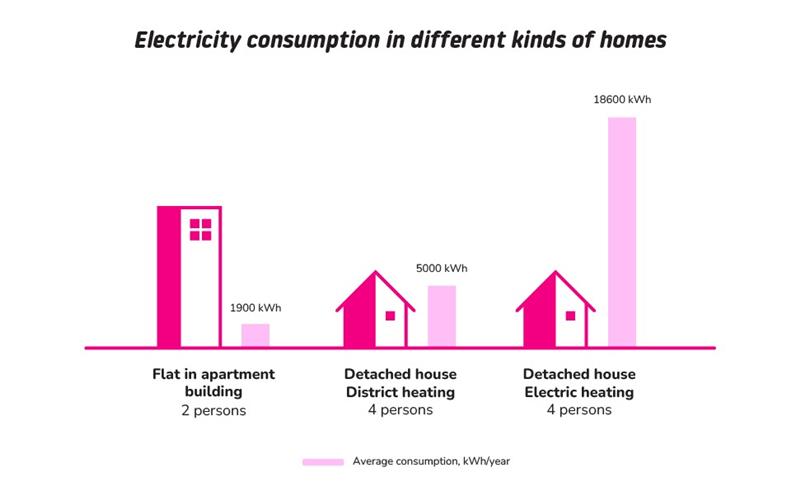
In a studio apartment, electricity consumption is usually low, while a family of four in an apartment building may experience consumption spikes from hot showers, sauna use, and household appliances.
Most apartment buildings use district heating, which means heating does not add to electricity consumption. The share of electricity in the monthly budget is small, and price fluctuations have a moderate impact on the household economy. Therefore, the contract type is of limited importance.
Jakob Frants’ tip for choosing an electricity contract: For apartment building dwellers, both the risks and possible savings related to electricity consumption remain moderate, so the contract can be chosen according to personal preference.
Electric heating and higher consumption – what influencing options do you have?
In a detached house, the electricity bill often has a greater impact on the monthly budget than in an apartment or terraced house with district heating.
Especially in houses with direct electric heating, cold spells can quickly increase electricity use due to heating. Therefore, supplementing electric heating with other forms of heating directly reduces electricity consumption. For example, an air source heat pump provides the same amount of heat with less electricity and helps to level out winter consumption peaks.
Since heating accounts for such a large share of total consumption in winter, using a dishwasher, for example, hardly shows up in consumption tracking. In addition: the larger the house and the more residents, the higher the total consumption.
Jakob Frants’ tip for choosing an electricity contract: If you have exchange electricity, schedule high-consumption activities like car charging and sauna use during lower-rate periods. If you prefer a more stable and predictable monthly bill, a fixed-price or hybrid contract is a good choice.
Smart home and automated consumption – make the most of exchange electricity
Smart homes make it possible to shift electricity usage to cheaper times with minimal effort.
The Vaasan Sähkö Smart Home app and the Power Hub installed on your electricity meter monitor consumption in real time. With these, you can automate the charging of your electric car to the cheapest periods. In 2026, automation will also be expanded to include the optimization of heating and solar panels.
The user sets the system’s boundaries and goals, such as the charging time and level for the car. Power Hub monitors the main fuse capacity and can temporarily reduce charging power if several appliances are running at the same time. This prevents the main fuses from overloading. Consumption remains under control, and you benefit from price fluctuations without constant monitoring.
Jakob Frants’ tip for choosing an electricity contract: If you live in a smart home, you can best take advantage of the ability to schedule your electricity use during low spot prices by choosing an Exchange Electricity or Influencer contract from Vaasan Sähkö.
How to find the electricity contract that’s right for you?
1. Which matters more to you: peace of mind or savings?
Consider whether you value predictability over the opportunity to optimize and save. A fixed-price contract offers peace of mind, as you know in advance what your electricity will cost and don’t have to track spot prices. Life runs smoothly, without price spikes causing stress.
Exchange Electricity suits you if you’re ready to follow prices and schedule your consumption. At best, you’ll save, but you must also accept the risks of price fluctuations.
2. How much does the price of electricity actually affect your bill?
Your electricity bill consists of the energy price, distribution fee, and electricity tax. You can only influence the energy price with your contract choice. It’s wise to consider possible savings in euros, not just cents per kilowatt-hour.
- How much do you consume monthly?
- How many euros could you save at most per month or year?
“If the potential savings are €15–€20 per month, you should also consider the risk. During a cold winter, the costs of exchange electricity can rise much higher than with a fixed-price contract. A single month could be up to €200 more expensive.” – Jakob Frants, Sales Manager at Vaasan Sähkö
3. Read the contract terms carefully
The range of electricity contracts is constantly evolving, and contracts are often becoming more complex. The simplest option is the traditional fixed-price contract, but there are also hybrid contracts, such as Vaasan Sähkö Influencer, and contracts where the price changes several times a year.
If the contract type is new to you, familiarize yourself with how it works. How is the price determined, can it change, and how long is the commitment?
“The most important thing is that you understand what you are committing to and under which terms. If anything is unclear, don’t hesitate to ask – customer service exists so you can make your decision confidently, knowing what you’re choosing.” – Jakob Frants, Sales Manager at Vaasan Sähkö
Expert: Jakob Frants, Sales Manager, Vaasan Sähkö.
Frants is responsible for electricity sales to private customers and small businesses, product pricing, the development of contract types, and Smart Home services.
You might also be interested in
-
 Energy tips
Influencer Electricity Contract – Who Should Consider It?
Influencer is a hybrid contract that combines the predictability of a fixed price with the opportunity to save with spot…
-
 Energy tips
Why do electricity contracts have different prices? This is how the price of electricity is formed
Electricity contract prices vary depending on how and when the electricity is purchased: exchange electricity follows the market price for…
-
 Energy tips
Electricity contract guide: which contract is right for you?
The choice of electricity contract depends on what kind of electricity user you are and how much you can influence…